
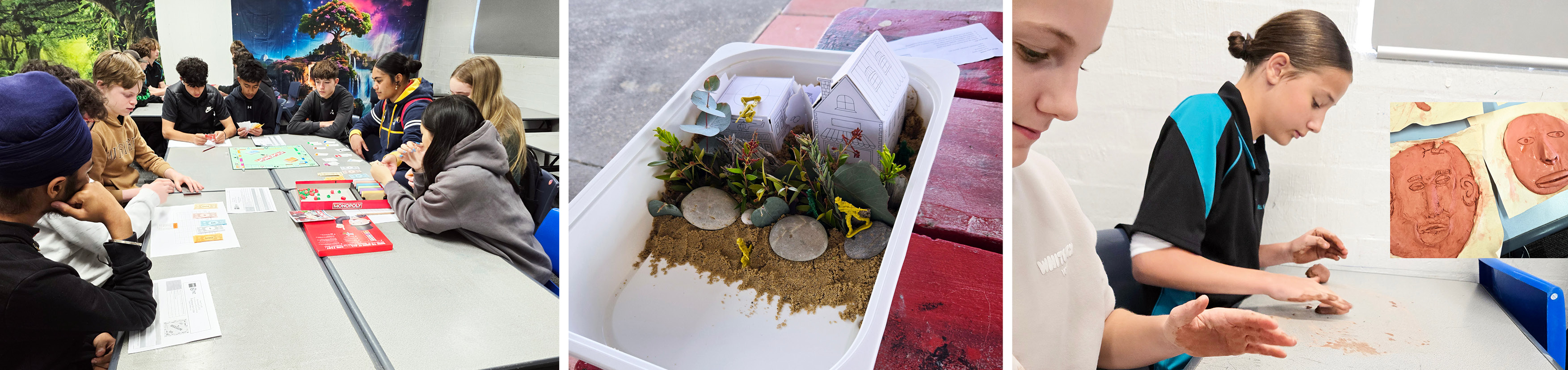
Humanities and Social Sciences (HaSS) is an engaging and challenging learning area at Calwell High School. HaSS incorporates the disciplines of History, Geography, Civics and Citizenship, and Economics and Business. Students explore how people interact with each other, with environments, and across time and place.
Subjects are taught in line with the Australian Curriculum. Across all HaSS subjects, students develop critical thinking and inquiry skills that support deep understanding of the world around them.
Year 7
Semester 1
Students will engage in geographical and civics inquiries to explore how people, places and systems are interconnected. In Term 1, they will investigate the importance of water as a global resource, analysing how it is used, valued and distributed, and how hazards such as floods and droughts impact communities. They will also examine liveability through mapping, data analysis and case studies, exploring how access to services, infrastructure and environmental quality influences everyday life.
In Term 2, students will explore how Australia’s democratic system is shaped by the Constitution and the legal system, and how shared values support community cohesion. Throughout the semester, they will develop skills in collecting and analysing information, identifying perspectives, and constructing explanations and arguments to communicate their understanding.
Semester 2
Students will explore the historical significance of the ancient past, including the histories of early First Nations Peoples of Australia. They will identify the causes and effects of significant events, developments and achievements associated with individuals and groups in Australia and other ancient societies. Students will describe the social, religious, cultural, economic, environmental and political aspects of ancient civilisations, including changes and continuities over time. They will develop historical inquiry skills by locating and identifying primary and secondary sources, examining their origins, content, context and purpose, and evaluating their accuracy and usefulness as historical evidence. Students will also explore different historical interpretations of significant events and individuals. They will apply historical knowledge, concepts, terminology and evidence to construct descriptions, explanations and historical arguments. These skills will be developed through depth studies of Ancient Australia and selected ancient civilisations, including Greece, Egypt, India, China or Rome.
Year 8
Semester 1
Students will apply inquiry skills to explore geographical and civics concepts. In Term 1, they will investigate the causes and impacts of natural hazards and disasters, using research and data analysis to examine how communities respond and adapt. They will propose solutions to real-world challenges through group discussions and individual investigations.
In Term 2, students will explore the structure and function of Australian democracy, examining how laws are made, how political parties operate, and how individuals can participate in democratic processes. They will also consider how diversity shapes a sense of belonging and contributes to Australia’s democratic values.
Across the semester, students will strengthen their ability to interpret information, analyse perspectives, and communicate their ideas clearly.
Semester 2
Students will explore the period from the end of the ancient world to the beginning of the modern period (c. 650–1750 CE), a time characterised by significant social, cultural, political and economic developments, increased contact between societies, exploration and colonisation. Through depth studies of Medieval Europe and Polynesian expansion across the Pacific, students will investigate the social structures, beliefs, lifestyles and significant events that shaped these societies. In Medieval Europe, students will examine feudalism, warfare, crime and punishment, and the devastating impact of the Black Death. In their study of Polynesian expansion, students will investigate the origins and migration of Polynesian peoples, their sophisticated navigation techniques, and the rich cultural traditions and shared histories that continue to connect Pacific communities today. Students will develop historical inquiry skills by analysing primary and secondary sources, evaluating historical evidence, examining causes and effects, and using historical knowledge, concepts and terminology to construct explanations and historical arguments.
Year 9
Semester 1
Students will explore how environmental and economic systems are interconnected through practical inquiry and analysis. In Term 1, they will investigate the world’s major biomes, identifying their key features and analysing how natural processes and human activities shape these environments. They will examine how biomes support food production and explore strategies to address global food security challenges.
In Term 2, students will shift their focus to economics and business, investigating Australia’s role in the global economy. They will analyse how trade with Asia influences economic decision-making, explore how businesses create competitive advantage, and evaluate the impacts of consumer and financial decisions.
Across the semester, students will apply skills in data interpretation, critical thinking and problem solving to develop informed, evidence-based conclusions.
Semester 2
Students will explore the history of the making of the modern world from 1750 to 1918, a period characterised by significant political, social, economic and technological changes, industrialisation, colonisation and global conflict. Through depth studies of colonisation and World War I, students will investigate the causes and consequences of European expansion, with a particular focus on British colonisation of India and its impact on Indian society. Students will examine the causes of World War I, the significant events and developments of the conflict, Australia's involvement, and its lasting effects on individuals and societies. Students will develop historical inquiry skills by formulating and researching historical questions, locating and analysing primary and secondary sources, evaluating evidence and examining different historical perspectives. They will apply historical knowledge, concepts and terminology to construct explanations and evidence-based historical arguments.
Year 10
Semester 1
Students will undertake complex geographical and economic inquiries to deepen their understanding of how people and systems interact. In Term 1, they will investigate a real-world geographical issue, collecting and analysing primary and secondary data to identify patterns and draw conclusions. They will propose and evaluate strategies to address the issue, using evidence to justify their recommendations.
In Term 2, students will examine how economic systems influence the decisions of governments, businesses and consumers. They will analyse economic indicators, explore superannuation and government intervention, and apply entrepreneurial thinking to develop a business plan.
Throughout the semester, students will strengthen their analytical, problem-solving and communication skills to explain their findings and support their ideas.
Semester 2
Students will explore the historical significance of the period from 1918 to the early 21st century, a time characterised by significant political, social, cultural and economic changes in Australia and internationally. Through studies of World War II and the post-war world, students will investigate the causes and consequences of major events, developments, turning points and movements that shaped modern history. They will examine the rise of totalitarian regimes, the persecution of Jewish people during the Holocaust, the causes and consequences of World War II, and Australia's involvement in the conflict. Students will also explore significant social and political changes in post-war Australia, including the influence of individuals, groups, institutions and movements in shaping Australian society and global developments. Students will develop historical inquiry skills by analysing and evaluating primary and secondary sources, examining different historical perspectives and interpretations, and using historical evidence, concepts and terminology to construct explanations and historical arguments.
Assessment
Assessment tasks may include research projects, tests, creative tasks, portfolios of work, oral presentations, group work, essays, film studies, reports, posters and source analysis.